Table of Contents
- Is Hypochlorous Acid Safe for Kids: The Short Answer
- How Hypochlorous Acid Works Against Germs and Why That Matters for Children
- Hypochlorous Acid Safe for Babies: Age-Specific Guidance
- How to Use Hypochlorous Acid Spray Safely Around Children
- Hypochlorous Acid on Child Eczema and Other Skin Conditions
- Hypochlorous Acid for Cleaning Toys and Play Surfaces
- Why Hypochlorous Acid Is Different from Bleach and Traditional Disinfectants
- Common Safety Concerns and What the Evidence Shows
- Frequently Asked Questions
Last Updated: October 21, 2026
Is Hypochlorous Acid Safe for Kids: The Short Answer
Hypochlorous acid safe for kids (HOCl) is confirmed when used as directed on age-appropriate products. Created from water and salt, it works gently on skin without the harsh chemicals in traditional disinfectants. At e11ement, we've formulated our hypochlorous acid products with families in mind, alcohol-free, hypoallergenic, and dermatologist-tested for all ages.

Properly formulated hypochlorous acid spray is gentler than bleach, phenols, or alcohol-based alternatives, and your skin naturally produces this compound as part of its immune response.
This guide covers age-specific guidance, application tips, and when to choose hypochlorous acid over other options.
How Hypochlorous Acid Works Against Germs and Why That Matters for Children
Hypochlorous acid works against a broad range of pathogens without harsh chemicals or extended contact time.

The way HOCl works is fundamentally different from bleach or alcohol-based sprays:
- No harsh fumes, Your child won't inhale toxic vapors
- No skin burns, Unlike bleach, it doesn't damage living tissue
- No drying effect, Alcohol strips skin; hypochlorous acid doesn't
Hypochlorous Acid Safe for Babies: Age-Specific Guidance
For infants and newborns, hypochlorous acid should be used only on intact skin, with a product formulated for skin contact, and kept away from eyes, mouth, and open wounds. Babies have thinner skin and developing immune systems, so the approach is more conservative.

Why age changes the advice
A newborn's skin barrier is still maturing, and the surface area relative to body weight is much higher than in an adult, so irritation shows up faster. HOCl isn't unsafe for babies, the product must simply be formulated for skin, applied sparingly, and supervised.
Age-by-age guidance
| Age Group | Safe Uses | Avoid | Application Notes |
|---|---|---|---|
| Newborns (0-3 mo) | External intact skin only, if a pediatrician agrees | Eyes, mouth, diaper area, open skin | Minimal use; patch test first; consult pediatrician |
| Infants (3-12 mo) | Hands, arms, legs after outdoor play | Face, mouth-accessible areas, broken skin | Supervise drying; keep spray out of reach |
| Toddlers (1-3 yr) | General skin, minor scrapes after water cleaning | Eyes, deep or open wounds | Let air dry; apply yourself |
| Preschoolers (3-6 yr) | Skin care, toy and surface cleaning | Direct eye contact | Begin guided independent use |
| School-age (6+ yr) | Full range of label-approved uses | Per product label | Can apply independently with instruction |
How to read a hypochlorous acid label before using it on a child
Not all HOCl products are interchangeable, a kitchen-counter spray isn't automatically appropriate for a child's skin. Check four things on the label:
- Intended use. Look for explicit skin-contact language such as "face and skin spray" or "for skin." Surface disinfectants may carry different formulation and labeling requirements and should not be repurposed for skin.
- Concentration. HOCl products range widely. A common skin-care formulation is around 0.015%, while some surface products are stronger. Use the concentration the label specifies for skin, and do not dilute or concentrate a product yourself.
- pH. HOCl is most stable and effective at a mildly acidic pH, typically 3.5-6 (Hypochlorous Acid as a Potential Wound Care Agent). A listed pH signals formulation quality; without one, you have less to go on.
- Ingredients and claims. A skin product should list water, salt, and hypochlorous acid, and little else if it is marketed as gentle. Be cautious with added fragrances or preservatives if your child has sensitive skin.
Newborns (0-3 months)
Use hypochlorous acid only on external, intact skin, and only after checking with your pediatrician, especially if your baby was premature or has a skin condition. Never spray the diaper area or skin folds; for diaper rash, the first step is a pediatrician's assessment, not a new product.
Infants (3-12 months)
As skin matures, a skin-formulated HOCl spray can be used on hands, arms, and legs after outdoor play or shared surfaces. Avoid the face and any area the baby can put in their mouth. Apply a light mist, let it air dry, and wash hands before feeding.
Toddlers (1-3 years)
Toddlers benefit from HOCl for post-play hygiene and minor scrapes after the area has been cleaned with water. Apply to clean skin, let it air dry, and keep the bottle on a high shelf, toddlers are skilled at finding spray bottles.
What the evidence does and does not show for babies
The strongest HOCl evidence comes from adult wound-care and skin-condition research; studies in newborns and infants are limited, so guidance for this age group leans conservative. That doesn't mean HOCl is unsafe for babies, it means using a skin-formulated product, a patch test, and a pediatrician's input.
How to Use Hypochlorous Acid Spray Safely Around Children
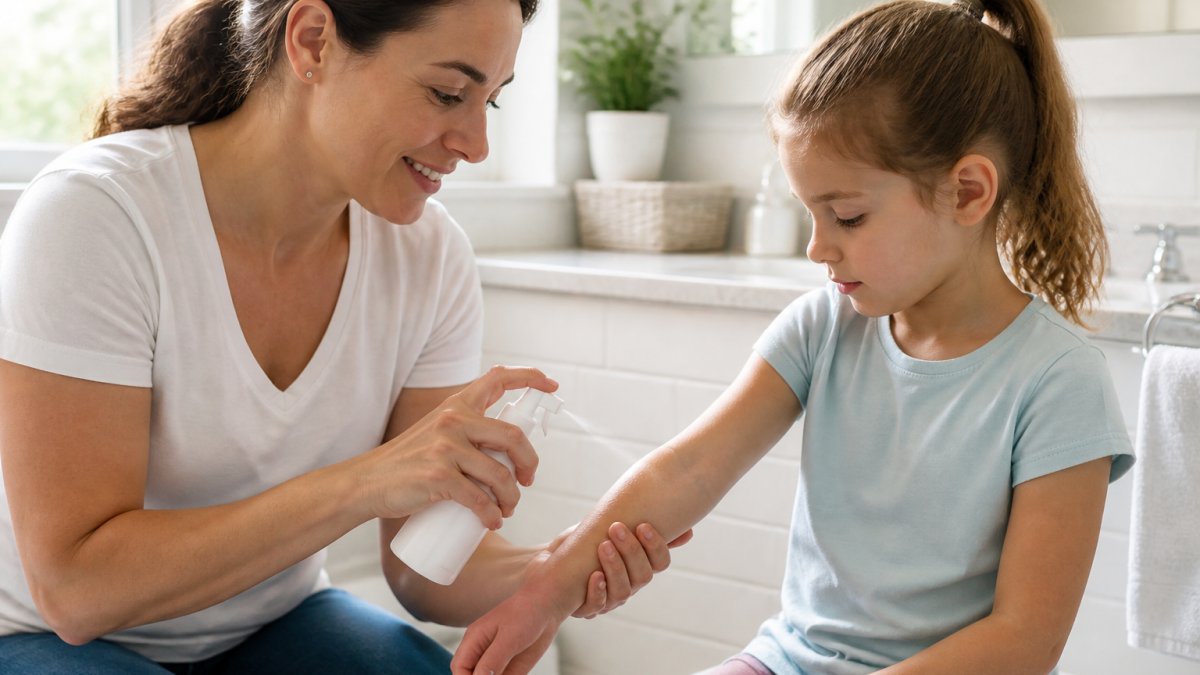
Start with a patch test on a small area of skin. Most children tolerate hypochlorous acid without issue, but wait 24 hours and watch for redness or irritation before full use.
Step-by-step application:
- Clean the area first, Wash with water and mild soap if the skin is visibly dirty
- Spray lightly, A light mist is enough; heavy saturation isn't more effective
- Allow air drying, Don't wipe off; let it dry naturally (takes 30-60 seconds)
- Supervise young children, Keep the spray out of reach and apply it yourself for kids under 5
Common scenarios and how to handle them:
- After outdoor play: Spray hands and exposed skin to reduce germs before meals or touching the face
- Minor scrapes or cuts: Clean with water first, then apply hypochlorous acid to support healing
- Post-sports or gym: Athletes benefit from refreshing spray after workouts; teens can apply independently
Store hypochlorous acid in a cool, dark place away from direct sunlight. Most formulations stay effective 6-12 months when stored properly; check your label.
Hypochlorous Acid on Child Eczema and Other Skin Conditions
Children with eczema, rosacea, or other inflammatory skin conditions often struggle with traditional disinfectants that worsen dryness and irritation. Hypochlorous acid is gentler because it doesn't strip the skin barrier the way alcohol or harsh soaps do.
For eczema specifically: Hypochlorous acid can help manage secondary bacterial infections that complicate eczema flare-ups (ncbi.nlm.nih.gov).
However, hypochlorous acid is not a treatment for eczema itself. It's a supportive tool. Your child still needs their regular eczema care, moisturizers, medical-grade creams, and dermatologist oversight.
Using hypochlorous acid with eczema treatment:
- Apply hypochlorous acid first to clean, dry skin
- Wait 2-3 minutes for complete drying
- Follow with your child's prescribed eczema medication or moisturizer
For severe eczema, consult your dermatologist before introducing hypochlorous acid to see whether it complements your child's routine or should be avoided during certain treatment phases.
Hypochlorous Acid Spray for Face and Skin - 240mL / 8oz →
Hypochlorous Acid for Cleaning Toys and Play Surfaces
Hypochlorous acid spray cleans both soft toys and hard surfaces without toxic residue.
How to clean toys safely:
- Plastic toys: Spray lightly, let sit for 60 seconds, wipe with a damp cloth
- Fabric toys and stuffed animals: Light spray on the surface; air dry completely before the child plays
- Bath toys: Spray interior and exterior, rinse with water, air dry
Unlike bleach-based cleaners, hypochlorous acid breaks down into salt and water, leaving no toxic residue, your child can touch a cleaned surface once it dries.
For toys that go in mouths (teethers, pacifiers), clean with water and mild soap first, then use hypochlorous acid as a secondary disinfectant step.
Why Hypochlorous Acid Is Different from Bleach and Traditional Disinfectants
Bleach (sodium hypochlorite) and phenol-based disinfectants are strong antimicrobials but carry significant downsides for children.
Bleach:
- Produces toxic fumes that irritate airways
- Burns skin on contact
- Leaves chemical residue
Alcohol-based disinfectants:
- Dry out skin and disrupt the skin barrier
- Can irritate eyes and mucous membranes
- Evaporate quickly, leaving residue
Hypochlorous acid (HOCl):
- Mimics the body's natural immune response
- Breaks down to salt and water, no toxic residue
- Works quickly on contact
e11ement's formulation uses stabilized hypochlorous acid at a safe concentration (0.015%) with water and salt.
Common Safety Concerns and What the Evidence Shows
Most parents asking whether HOCl is safe for kids want practical answers: what happens if it gets in eyes, is breathed in, or is swallowed. Here is each exposure route, separating what studies show from marketing claims.
Exposure routes: what to do in each case
Eyes. A brief mist of a skin-formulated HOCl product is typically irritating rather than damaging.
Mouth and ingestion. Small amounts of a properly diluted, skin-formulated HOCl product aren't expected to cause serious harm, but these products aren't meant to be ingested.
Inhalation. HOCl does not produce the harsh fumes associated with bleach, but a fine mist in a small, poorly ventilated space can still irritate airways.
Skin. Irritation is the most common skin reaction and usually shows up as mild redness or dryness.
What the evidence shows, and what it does not
HOCl has a meaningful body of research behind it, particularly in wound care, skin conditions, and surface disinfection, supporting the claim that it is generally gentle on skin. It does not establish, in large pediatric trials, that every HOCl product is safe for every child in every situation. Three caveats matter:
- Product differences matter. Studies on one formulation do not automatically apply to another. Concentration, pH, and intended use vary.
- Pediatric-specific data is thinner. Much of the clinical evidence is in adults; guidance for children leans on that evidence plus clinical experience.
- Marketing is not evidence. Social-media anecdotes about HOCl clearing eczema or preventing infections are not a substitute for a clinician's advice, especially for a child with a medical condition.
HOCl alongside eczema care
HOCl can be a supportive add-on for eczema-prone skin, but it doesn't replace prescribed treatment. Patch test, wait 24 hours, and watch for dryness or irritation. Apply to clean, dry skin, let it dry fully, then follow with the child's prescribed moisturizer or medication. Don't mix HOCl with topical steroids without medical guidance, and check with the dermatologist before using it during a severe flare.
Storage, shelf life, and safe handling
HOCl degrades over time and breaks down faster with light and heat. Store bottles in a cool, dark place, keep caps tight, and check the label for an expiration date, many formulations are best within 6-12 months of opening. Don't decant into unlabeled bottles, and keep sprays on a high shelf or in a locked cabinet. If a bottle changes color, smell, or clarity, replace it.
Frequently Asked Questions
Is hypochlorous acid safe for kids and babies?
Hypochlorous acid is generally considered safe for children when used as directed on age-appropriate skin. For babies under 3 months, avoid direct application and consult a pediatrician first. For older infants and children, use products formulated specifically for skincare with lower concentrations (0.015%) and follow label instructions. Always supervise use and prevent ingestion or eye contact.
How do you use hypochlorous acid spray safely around children?
Spray the product onto clean skin and allow it to air dry before applying other products. For children, apply to small areas first to check for any sensitivity. Keep the bottle out of reach of young children. Do not spray directly into eyes or mouth. If your child has open wounds or severe skin irritation, consult a healthcare provider before use. Store in a cool, dry place away from direct sunlight to maintain stability.
Can hypochlorous acid help with a child's eczema?
Hypochlorous acid can be used to gently refresh the skin and help maintain a clean complexion. However, eczema is a complex condition that often requires medical supervision. Use hypochlorous acid as a complementary step in your child's routine, not as a replacement for prescribed eczema treatments. Always consult your child's dermatologist or pediatrician before introducing new products, especially for chronic skin conditions.
Is hypochlorous acid safe to use on children's toys and surfaces?
Yes, hypochlorous acid is safe for cleaning toys and play surfaces when used as directed. It is non-toxic and does not leave harmful chemical residues. Spray the product on toys or surfaces, allow contact time as recommended, then rinse with water if needed. This makes it ideal for daycares, schools, and homes where children play. Always check toy materials first to ensure the spray does not damage plastic or finishes, and allow items to dry completely before children use them again.